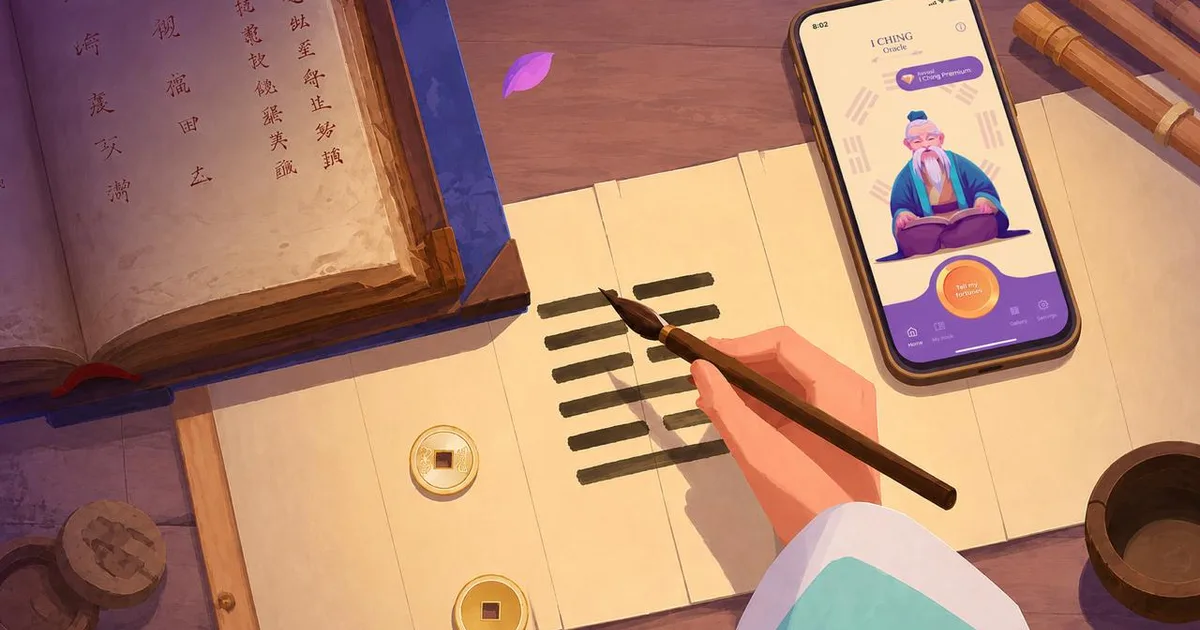
Hexagram 1: The Creative (Qian)
Hexagram 1 opens the traditional sequence of the I Ching for a reason — it's the purest expression of the system's active, initiating principle, built from six unbroken yang lines and nothing else. Known as Qian, or The Creative, it's the hexagram of initiative, leadership, and pure creative force, unmixed with any yielding or receptive quality. This article breaks down what it actually represents, line by line, and what it tends to mean when it turns up in a reading of your own.
Hexagram 1 at a Glance
Hexagram 1 is made of the trigram Qian (Heaven) doubled — Heaven over Heaven, the only hexagram in the entire sequence built from a single trigram repeated with no variation. All six lines are unbroken (yang). Where Hexagram 2, The Receptive, is entirely yielding earth, Hexagram 1 is entirely active force — the two form the foundational pair that the rest of the 64 hexagrams are built in relation to.
The Judgment: What Hexagram 1 Represents
Traditionally, the Judgment of Hexagram 1 speaks of sublime success through what is right and firm — a situation where genuine, well-earned progress is available, but only to someone acting with integrity and steady persistence rather than force alone. It's a hexagram of enormous potential, not a guarantee: the energy it describes is real and considerable, but it has to be channeled through patience and correct conduct, or it curdles into the overreach the later lines warn against.
The Image: Heaven in Motion
The traditional Image associated with Hexagram 1 describes the movement of heaven as vigorous and untiring — the sun rising and setting without pause, day after day. The advice drawn from this image is for a person of strong character to likewise make themselves strong and untiring: not frantic activity, but sustained, disciplined effort that doesn't waver.
Not frantic activity, but sustained, disciplined effort that doesn't waver.
The Six Lines of Hexagram 1
Each of Hexagram 1's six lines is traditionally described through the image of a dragon at a different stage of its rise — together they form one of the clearest metaphors for the arc of ambition in the entire I Ching.
- First line — the hidden dragon. The dragon is submerged, unseen, not yet ready to act. The advice is to wait: your position isn't yet strong enough to move, and acting now would be premature.
- Second line — the dragon appears in the field. The dragon has surfaced and become visible to others. This is a moment to seek out guidance or support from someone more experienced — you're ready to be seen, but not yet ready to lead alone.
- Third line — ceaseless activity, day and night. The dragon works tirelessly but remains cautious, aware of the danger in its position even as it strives. Effort is appropriate here, but so is vigilance.
- Fourth line — the dragon hesitates over the depths. Poised between rising further and holding back, this line describes a genuine choice point. There's no error in either advancing or staying, provided the choice is deliberate rather than reckless.
- Fifth line — the flying dragon in the heavens. The moment of full realization — influence and position fully achieved. Traditionally the most auspicious line in the entire hexagram, describing someone whose action benefits others precisely because their position is now secure and rightly earned.
- Sixth line — the arrogant dragon will have cause to repent. Flown too high, past the point of usefulness, this final line is the hexagram's central warning: unchecked ambition that outruns its own position invites a fall. Success sustained too long without restraint turns into its opposite.
Read together, the six lines describe a single arc — patient waiting, visibility, disciplined effort, a real choice, full achievement, and finally the danger of overreaching past that peak. It's less a set of separate fortunes than a single cautionary trajectory.
Read together, the six lines describe a single arc — patient waiting, visibility, disciplined effort, a real choice, full achievement, and finally the danger of overreaching past that peak.
What It Means When Hexagram 1 Appears in Your Reading
On its own, Hexagram 1 is one of the most encouraging hexagrams to draw — it signals that you have real energy, initiative, and legitimacy behind you right now. The caution built into the hexagram is proportional to that strength: the same force that lets you start something significant can just as easily tip into arrogance or overreach if it isn't tempered by patience. Whichever line is changing in your specific cast tells you exactly where you sit on that dragon's arc — check it against the six lines above rather than reading the hexagram as a flat, one-size-fits-all message. For the app's own full reading text and imagery for this hexagram, see Hexagram 1 — Creativity.
The same force that lets you start something significant can just as easily tip into arrogance or overreach if it isn't tempered by patience.
Hexagram 1 in Career and Leadership Questions
Hexagram 1 shows up often in questions about starting something — launching a project, proposing an idea, stepping into a leadership role for the first time. It's one of the hexagrams we cover in our guide to I Ching for career decisions, precisely because "do I have the standing to lead here" is such a common professional question, and this hexagram answers it about as directly as the I Ching ever does: yes, provided the effort stays disciplined and doesn't outrun itself.
FAQ
Is Hexagram 1 a "good" hexagram? Broadly yes — it's traditionally read as one of the most auspicious hexagrams in the sequence, but its core lesson is about tempering strong momentum with patience and integrity, not just riding pure luck.
What's the difference between Hexagram 1 and Hexagram 2? Hexagram 2, The Receptive, is Hexagram 1's direct counterpart — entirely yielding earth rather than entirely active heaven. Where Hexagram 1 describes initiating force, Hexagram 2 describes the receptive, supportive quality that completes it.
What does it mean if Hexagram 1 has changing lines? Look at which specific line (or lines) is changing — each of the six describes a distinct stage of the dragon's arc, from cautious waiting through full achievement to the danger of overreaching. The changing line usually carries the most specific advice for your situation.
Does Hexagram 1 always mean "yes" to a yes/no question? Not reliably — the I Ching resists binary questions in general. Hexagram 1 is better read as "you have real capacity and legitimacy here" than as a flat yes, with the specific line and any resulting hexagram shaping exactly what that capacity is for. For more on framing questions well, see our beginner's guide to reading the I Ching.
Curious what you'd draw today? Cast your own hexagram in the app — or read the app's full take on Hexagram 1 — Creativity to compare it with the traditional reading above.