I Ching vs Tarot: Differences
Both systems get lumped together as "divination," yet they work in almost opposite ways. Someone new to either practice often assumes the I Ching is just "Chinese tarot" — a deck-like set of symbols you shuffle and interpret. It isn't. Understanding the difference matters if you want a genuinely useful answer instead of just a comforting one.
This article lays out how each system actually works, where each one shines, and how to decide which — or whether both — fits the question in front of you.
What the I Ching Is
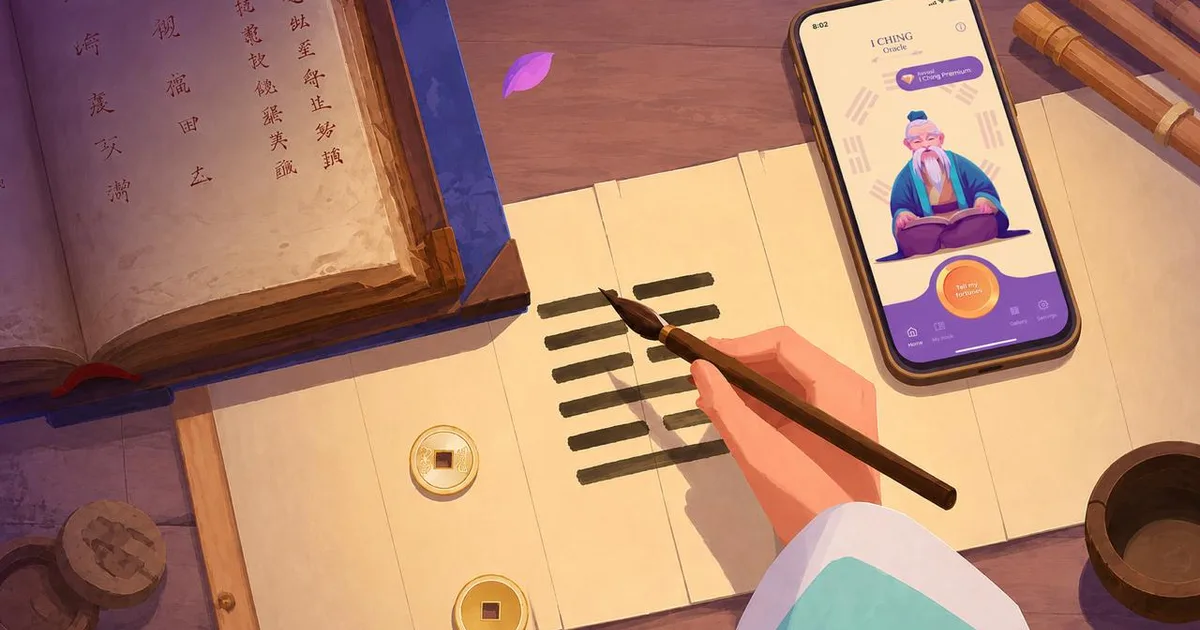
The I Ching, or Book of Changes, is a roughly 3,000-year-old Chinese text built around 64 hexagrams — six-line figures made of broken (yin) and unbroken (yang) lines. You don't choose a hexagram; you generate one, traditionally by tossing three coins six times, letting chance build the figure line by line from the bottom up. Each hexagram describes a situation — its Judgment and Image speak in terms of natural forces, seasons, and social relationships rather than fixed characters or destinies. Crucially, individual lines can be "changing," meaning the hexagram you drew is already becoming a different one — the system is explicitly built around movement and transformation, not a fixed snapshot.
What Tarot Is
Tarot is a 78-card deck — 22 Major Arcana and 56 Minor Arcana — with roots in 15th-century Italian playing cards that were later adopted for divination and esoteric symbolism. A reading involves shuffling and drawing cards into a spread (a single card, a three-card past/present/future line, the ten-card Celtic Cross, and so on), then interpreting each card's traditional meaning in the context of its position and its neighbors. Each card carries a fixed archetype — The Fool, The Tower, The Star — and much of a reading's skill lies in weaving those archetypes into a narrative for the question asked.
The Core Difference: Change vs. Archetype
This is the real distinction, and it's more useful than "one is Chinese and one is European." Tarot speaks in archetypes: each card is a fixed character or force (Death, the Emperor, the Hanged Man), and a reading builds a story from how those characters interact in the spread. The I Ching speaks in process: a hexagram isn't a character, it's a description of a moment in a larger cycle, and its changing lines tell you exactly where that moment is heading next.
The I Ching speaks in process: a hexagram isn't a character, it's a description of a moment in a larger cycle.
Practically, this means tarot tends to read like a scene — vivid, personal, easy to narrativize. The I Ching tends to read like a weather forecast — less colorful, but built to tell you about direction, timing, and the wisdom of waiting versus acting.
Which Questions Suit Each System
Neither system is "better" — they're tuned for different kinds of questions.
Tarot tends to shine for:
- Exploring the emotional layers of a situation
- Questions about relationships, identity, and inner conflict
- Open-ended "what do I need to see here" reflection
The I Ching tends to shine for:
- Questions about timing — is this the moment to act, or to wait?
- Situations involving hierarchy, duty, or other people's authority (work, family, institutions)
- Questions where you need to understand a process in motion, not just a static feeling
If you're facing a work decision, for example, the I Ching's language of timing and momentum tends to map more directly onto the situation than tarot's more symbolic, personal-growth register. See our guide to I Ching for career decisions for that in practice.
Can You Use Both Together?
Plenty of people do, and there's no rule against it. A common approach is to use tarot for the emotional or relational read on a question, and the I Ching for a second pass focused on timing and action. Using both on the exact same phrasing back-to-back can just produce noise, though — if you consult both, it helps to ask each system a slightly different angle of the same question rather than the identical one twice.
A common approach is to use tarot for the emotional or relational read on a question, and the I Ching for a second pass focused on timing and action.
Common Misconceptions
- "The I Ching is Chinese tarot." It isn't a card deck at all, and it doesn't use fixed archetypal characters — it's a coin- or yarrow-stalk-based text built around 64 hexagrams and their transformations.
- "Tarot is more visual, so it's less serious." The image-based format doesn't make tarot lightweight — the tradition behind the Major Arcana is as layered as any divination system.
- "One of them predicts the future and the other doesn't." Neither system is best understood as fortune-telling in the deterministic sense — both work better as structured tools for reflection and decision-making than as literal prophecy.
Neither system is best understood as fortune-telling in the deterministic sense — both work better as structured tools for reflection and decision-making than as literal prophecy.
FAQ
Is the I Ching harder to learn than Tarot? The core mechanic (casting a hexagram) is actually simpler than shuffling and laying a tarot spread — the learning curve is in interpretation, and both systems take real practice to read well.
Which one is more accurate? Neither is "more accurate" in a testable sense — accuracy here really means how well a system's language maps onto the question you're asking, and that depends on the question more than the system.
Can beginners start with the I Ching without any prior knowledge? Yes — you need a clear question and a way to cast a hexagram (traditionally three coins, or the I Ching: Fortune Teller app if you want it instantly). See our full beginner's guide to reading the I Ching to get started.
Do I need to believe in fate for either system to be useful? No — many people use both purely as structured reflection tools, a way to organize their own thinking about a decision rather than as literal prediction.
Curious to try the I Ching for yourself? Cast a hexagram in the app and see how differently it reads a question than a tarot spread would.