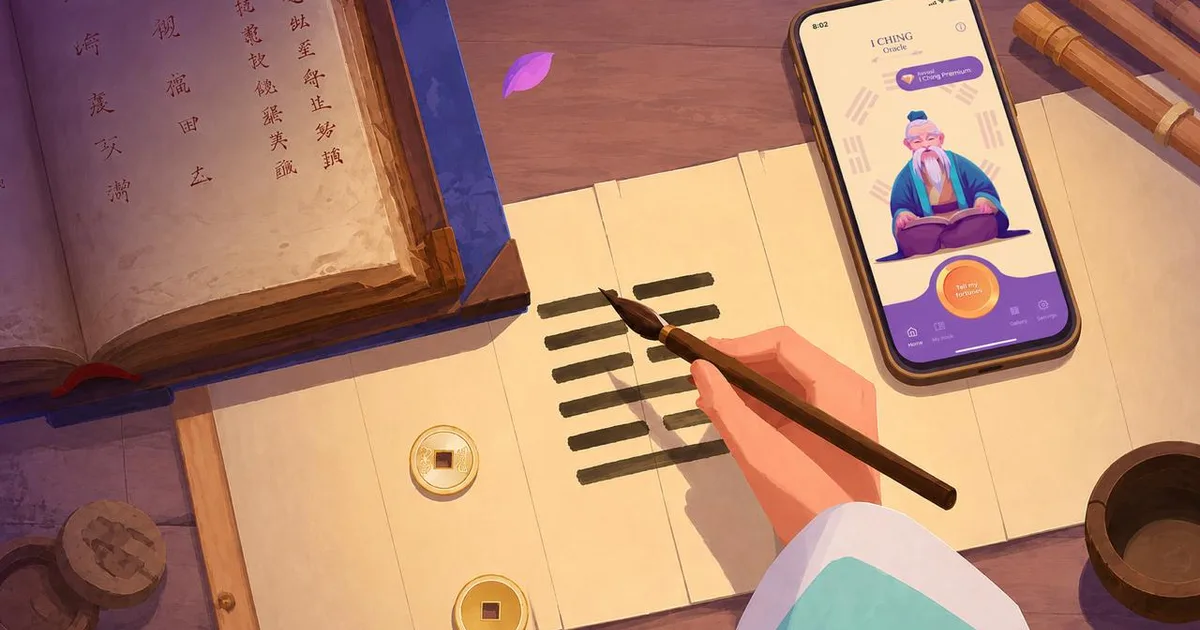
I Ching for Love and Relationships
Does he actually like me? Should I text first? Is this relationship worth fighting for, or worth walking away from? Questions about love rarely come with clean edges — they're tangled up with hope, fear, and a hundred small signals you can't stop replaying. The I Ching — the 3,000-year-old Book of Changes — has been used for exactly this kind of question for millennia, not because it can read another person's mind, but because it's built to describe the shape of a situation between two people, and where that situation is heading.
This guide covers how to bring a relationship question to the I Ching honestly, which hexagrams tend to appear around love, and how to read what you get.
Why the I Ching Works for Love Questions
Relationships are relationships between two changing people, not fixed states — which is exactly the territory the I Ching was built to map. It doesn't answer "does he love me" the way a magic 8-ball would; it describes the current dynamic between you and another person: whether it's building or fading, whether you're the one holding back, whether the timing is right or badly mismatched.
That framing matters more in love readings than almost anywhere else, because it's so easy to ask the I Ching to hand you a verdict on someone else's feelings — something it was never built to do, and something no honest system can actually deliver.
It describes the current dynamic between you and another person — not a verdict on their feelings.
How to Frame a Relationship Question
The way you phrase the question decides almost everything about how useful the reading will be — our guide to how the I Ching actually works covers the basics — for love specifically, the same rule applies twice as hard.
Weak framing hands your agency to someone else:
- "Does he love me?"
- "Will we get back together?"
Strong framing keeps the question pointed at you and the relationship itself:
- "What's really going on between us right now?"
- "What do I need to understand before I decide whether to reach out?"
- "What's my part in why this relationship feels stuck?"
The second set of questions gives the hexagram room to describe momentum, mismatch, and timing — the things that actually determine how a relationship unfolds — instead of forcing a coin-flip answer onto a system that thinks in terms of change and circumstance, not fixed fate.
Casting Your Hexagram
Once you've settled on a question, cast your hexagram — traditionally three coins tossed six times, or instantly with the I Ching: Fortune Teller app. For a relationship reading, three layers matter:
- The primary hexagram — the relationship as it stands right now.
- The changing lines — the part of the dynamic that's actively shifting, often the truest answer in the whole reading.
- The resulting hexagram — where things are heading if nothing changes course.
If there are no changing lines, the relationship is in a stable phase — good or difficult, but not currently in flux. Several changing lines mean you're in the middle of something that's actively moving, and the resulting hexagram deserves as much attention as the primary one.
Key Hexagrams for Love and Relationships
Certain hexagrams surface again and again around romantic questions. Here are seven worth knowing.
Hexagram 31 — Interaction
The hexagram of mutual attraction and courtship — two people drawn toward each other, testing the connection. When Interaction appears, it usually signals real, mutual pull rather than a one-sided crush, but it's an early-stage hexagram: the relationship hasn't been tested by time yet.
Hexagram 32 — Consistency
Where Interaction is the spark, Consistency is the long marriage — steady commitment that holds up over years. Seeing this hexagram around an established relationship is reassuring: the foundation is durable. Seeing it around a new one is a nudge to think about whether you're both ready for something that lasts.
Hexagram 37 — Family
This hexagram centers on the roles and responsibilities that hold a household or partnership together. It tends to appear when a relationship question is really about structure — who does what, whose needs get deferred, whether the partnership feels fair and stable day to day.
Hexagram 54 — Bride
A hexagram of caution, often appearing around mismatched relationships — different expectations, a lopsided balance of power, or a situation entered into without fully seeing it clearly. It's not automatically a "bad" reading, but it does ask you to look honestly at the terms of the relationship rather than only the romance of it.
Hexagram 44 — Coming to the Meeting
This hexagram often marks an unexpected encounter or a temptation that arrives uninvited — a new person, an old flame resurfacing, an attraction you didn't plan for. It counsels awareness over impulse: notice what's happening before you act on it.
Hexagram 38 — Discord
A hexagram of friction and misunderstanding between two people who see the same situation very differently. It shows up around recurring arguments or a relationship where communication has broken down. The advice is rarely to force resolution immediately — small, patient steps close the gap better than confrontation.
Hexagram 40 — Liberation
Release after tension — a hexagram that often appears around a breakup, a difficult conversation finally had, or the relief of letting go of something that had grown heavy. It's frequently a hopeful sign: pressure easing, room to breathe again.
A Short Example Reading
Say you've been talking to someone new and you're unsure whether to invest more in it. Instead of asking "does she like me?", you ask: "What's really going on between us right now?"
You cast Interaction with one changing line, moving toward Discord.
Read together, this suggests genuine mutual pull in the present moment — but the changing line flags something under the surface that hasn't been addressed, a mismatch in expectations or communication that hasn't surfaced yet. The resulting hexagram, Discord, isn't a doom sign; it's a heads-up to talk about the thing you've both been avoiding before it hardens into real friction.
Not "yes" or "no" — a clear-eyed read on where the connection actually stands.
That's the kind of answer a good I Ching reading gives about love: not a verdict on someone else's feelings, but a mirror held up to the relationship as it actually is.
Common Mistakes When Asking About Love
- Asking the I Ching to read someone else's mind. It can describe a dynamic between two people; it can't hand you a transcript of their private feelings.
- Re-casting the same question hoping for a better answer. If a reading about a relationship feels uncomfortable, that discomfort is often exactly the information you need — sit with it before asking again.
- Ignoring your own role in the reading. Love readings are still about you as much as the other person; skip that half of the picture and you'll miss most of the useful advice.
- Treating a hard hexagram as a verdict to end things. Hexagrams like Discord or Bride describe friction or mismatch, not a command — they're worth acting on thoughtfully, not reflexively.
If a relationship reading turns up an unexpectedly hard hexagram, it's worth checking whether you're reading the message accurately in the first place — see our post on common mistakes when consulting the I Ching for pitfalls that apply well beyond career questions.
FAQ
Can the I Ching tell me if someone loves me? Not directly — it doesn't have access to another person's private feelings. What it can describe is the dynamic between you: whether the connection is building, whether the timing is right, and what's likely getting in the way.
What hexagram means a new relationship is coming? There's no single hexagram fixed to "new love," but Interaction often appears around mutual attraction in its early stages, and Coming to the Meeting can mark an unexpected encounter. The specific hexagram you draw always matters more than any general association.
Should I ask the I Ching about the same relationship repeatedly? Generally not in quick succession. If an answer feels unclear or unwelcome, give it time to settle before casting again — frequent re-asking about the same unresolved situation tends to produce noise, not clarity.
Is it okay to ask about someone else's feelings directly? You can, but the more useful version of the question usually turns the lens back toward the relationship itself and your part in it — that's where the I Ching has the most to say.
Have a relationship question sitting with you? Cast a reading in the app and see what hexagram meets you where you are.