What Is the I Ching, Really?
Somewhere between a 3,000-year-old Chinese classic and a free app on your phone sits the I Ching — one of the oldest continuously used texts in human history, and, strangely, one of the more useful tools for a modern mind drowning in options. If you've never consulted it, the name alone can sound like something for a curio shelf: dusty, mystical, irrelevant. It isn't. This article explains what the I Ching actually is, where it comes from, and why — in an age of infinite information and very little clarity — it still earns a place in people's lives.
What the I Ching Actually Is
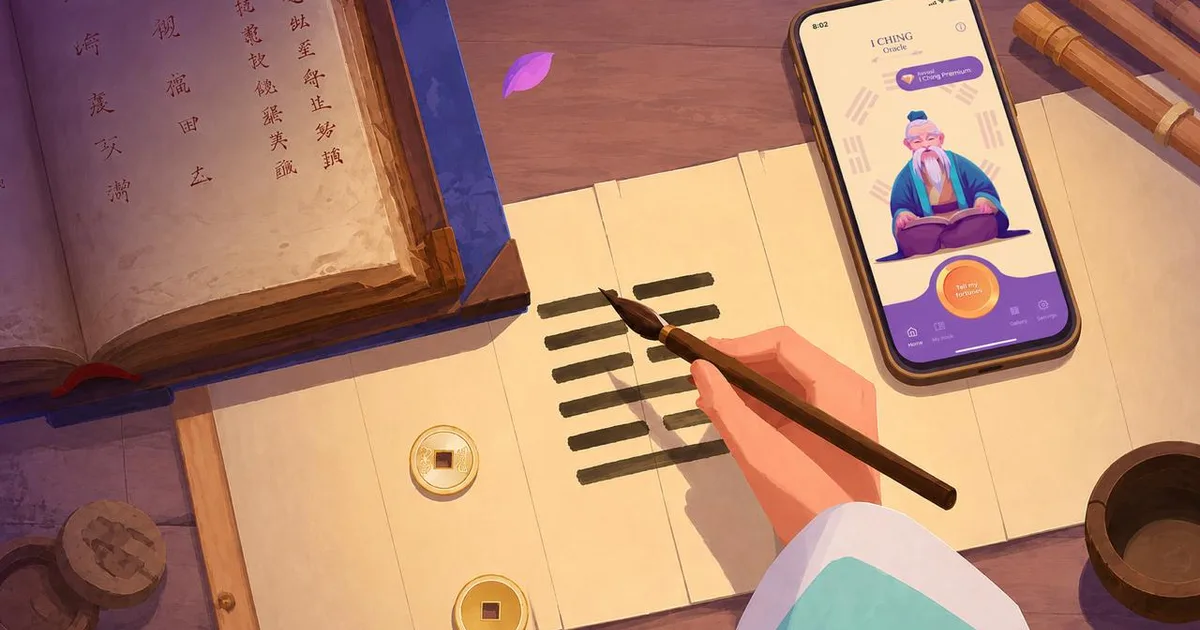
The I Ching — literally the "Book of Changes" — is a Chinese classical text built around 64 hexagrams: six-line figures made of broken and unbroken lines, each paired with a short Judgment and Image describing a particular kind of situation. You don't read it front to back like a novel. You consult it: you ask a real question, generate a hexagram through a chance-based method (traditionally three coins tossed six times), and read the text that corresponds to what you drew. At its core it's a structured way of describing the situation you're in, using a vocabulary of 64 archetypal states rather than a single fixed answer.
The Core Idea: Change, Not Fate
The name is the whole philosophy in miniature. Where a lot of divination systems imply a fixed destiny, the I Ching is built entirely around the opposite idea — that nothing stays as it is. Every hexagram is made of yin (broken) and yang (unbroken) lines, the two basic forces the entire system is built from, and any line can be "old" or "changing," meaning it's already tipping into its opposite. A hexagram isn't a verdict; it's a snapshot of a moment inside a much longer process of change. That's what separates it from most Western ideas of fortune-telling: it's less interested in what will happen than in what's happening right now, and which way it's moving.
A hexagram isn't a verdict; it's a snapshot of a moment inside a much longer process of change.
A Brief History, Fast
The earliest layer of the I Ching — the 64 hexagrams and their core judgments — dates to around the Western Zhou dynasty, roughly the 9th century BCE, used originally as a court divination manual. Over the following centuries, a set of philosophical commentaries known as the Ten Wings were added, traditionally associated with Confucius, turning it from a divination manual into one of the foundational texts of Chinese philosophy — required reading alongside the other Confucian classics for over two thousand years. It reached the West largely through Richard Wilhelm's early-20th-century translation, which caught the attention of psychologist Carl Jung; his interest in the text's logic of "meaningful coincidence" (he called it synchronicity) is a large part of why the I Ching became known outside China at all.
Why People Still Use It Today
It would be easy to assume a bronze-age divination manual has nothing to offer a smartphone-era life, but the opposite has turned out to be true, for a fairly specific reason: modern life doesn't suffer from a lack of information, it suffers from a lack of a way to sit with a decision. Search engines and AI assistants can hand you facts and options instantly, but not reflection — and the I Ching is, structurally, a reflection tool. Asking it a real question forces you to first articulate the question honestly, then sit with an answer that resists being skimmed. A handful of concrete reasons keep showing up:
- It slows down decisions that are moving too fast. Casting a hexagram takes a minute, but reading it properly takes longer — which is often exactly the pause a decision needed.
- It handles ambiguity better than a checklist. Career moves, relationships, and timing questions rarely reduce to pros and cons; the I Ching's language of shifting forces tends to match that ambiguity more honestly. See our guide to I Ching for career decisions for a concrete example.
- It's genuinely accessible now. You no longer need three coins and a translated commentary — an app like I Ching: Fortune Teller reproduces the traditional coin method digitally, in whatever language you read in.
- It rewards return visits. Unlike a one-off prediction, its 64 hexagrams form a vocabulary you get better at reading the more you use it — each consultation makes the next one easier to interpret.
Modern life doesn't suffer from a lack of information — it suffers from a lack of a way to sit with a decision.
What It's Not
A few misconceptions are worth clearing up early, because they're the main reason people write the I Ching off before giving it a real try.
- It's not a guarantee of the future. It doesn't claim to override human choice or outside events — it describes a situation's tendencies, not a locked-in outcome.
- It's not the same as Tarot. No cards, no fixed archetypal characters — a hexagram is generated by chance and describes a process in motion rather than a static scene. See I Ching vs Tarot if you're weighing the two.
- It's not a religion, and it doesn't require belief in anything supernatural to be useful. Plenty of people use it purely as a structured reflection method — a way to organize their own thinking, independent of any metaphysical claim about how the coins land.
It doesn't claim to override human choice or outside events — it describes a situation's tendencies, not a locked-in outcome.
How to Get Started
The traditional entry point is simple: pick a real question you're actually facing, cast a hexagram — three coins tossed six times, or the I Ching: Fortune Teller app if you'd rather skip the coin-counting — and read what comes up. Hexagram 1 is a good one to start familiarizing yourself with, since it's the opening hexagram of the traditional sequence and one of the clearest examples of how the system's imagery works. From there, our beginner's guide to reading the I Ching walks through the full method step by step.
FAQ
Is the I Ching a religious text? No — it's a philosophical and divinatory classic with roots in Confucian and Daoist thought, but consulting it doesn't require adherence to any religion or belief system.
How old is the I Ching, really? Its core layer dates to roughly the 9th century BCE, making it one of the oldest texts still in active, everyday use anywhere in the world.
Do I need to read the whole book to use it? No — most people consult it one hexagram at a time, as questions come up, rather than studying it cover to cover first. Familiarity builds naturally through repeated use.
Is it scientifically proven to work? No divination system is scientifically validated in a predictive sense, and the I Ching doesn't need to be understood that way to be useful — its value is best understood as a structured tool for reflection and decision-making, not a forecasting instrument.
Curious what the Book of Changes has to say about what's on your mind right now? Cast your first hexagram in the app and see for yourself.