I Ching for Anxiety and Uncertain Times
Some anxiety has an obvious source — a decision, a deadline, a person. But a lot of it doesn't. It's the low, constant hum of not knowing what's coming next, of circumstances that feel out of your hands. The I Ching — the 3,000-year-old Book of Changes — was built for exactly that kind of unease. Its entire premise is that nothing stays fixed; every situation, however stuck it feels, is already in motion toward something else. Used well, it doesn't erase uncertainty — it gives you a way to stand inside it steadily.
This guide covers why the I Ching is suited to anxious, uncertain moments, how to bring a question to it without adding more noise to your own head, and which hexagrams tend to show up when things feel unsettled.
Why the I Ching Helps With Anxiety
Anxiety usually isn't about the present moment — it's about an unwritten future, played on a loop, with the worst version on repeat. The I Ching can't tell you what will happen. What it does instead — as covered in more depth in what the I Ching actually is — is name the shape of right now: what's actually true about your situation as it stands, stripped of the catastrophic version your mind keeps rehearsing.
That reframing is often the actual relief. Uncertainty stops feeling like a void to fight and starts feeling like a phase — one with its own logic, its own timing, and, eventually, its own way through.
Uncertainty stops feeling like a void to fight and starts feeling like a phase with its own timing and its own way through.
How to Ask a Question When You're Anxious
When anxiety is running the show, it's tempting to ask something that's really just the anxiety in disguise: "Will everything be okay?" That question can't be answered honestly by any system, and chasing an answer to it usually feeds the loop instead of breaking it. For the basics of good framing, see our guide on asking the I Ching a question — here's how it applies specifically to anxious moments.
Weak framing asks for reassurance the I Ching can't honestly give:
- "Will everything be okay?"
- "Is something bad about to happen?"
Strong framing asks about your footing in the situation, not a guarantee about the future:
- "What do I need to understand about what I'm facing right now?"
- "How should I be holding this uncertainty?"
- "What's actually within my control here?"
The second set of questions gives the hexagram room to describe your real position — momentum, obstacles, what's genuinely yours to act on — instead of demanding a promise that no honest reading, from any system, can make.
Casting Your Hexagram
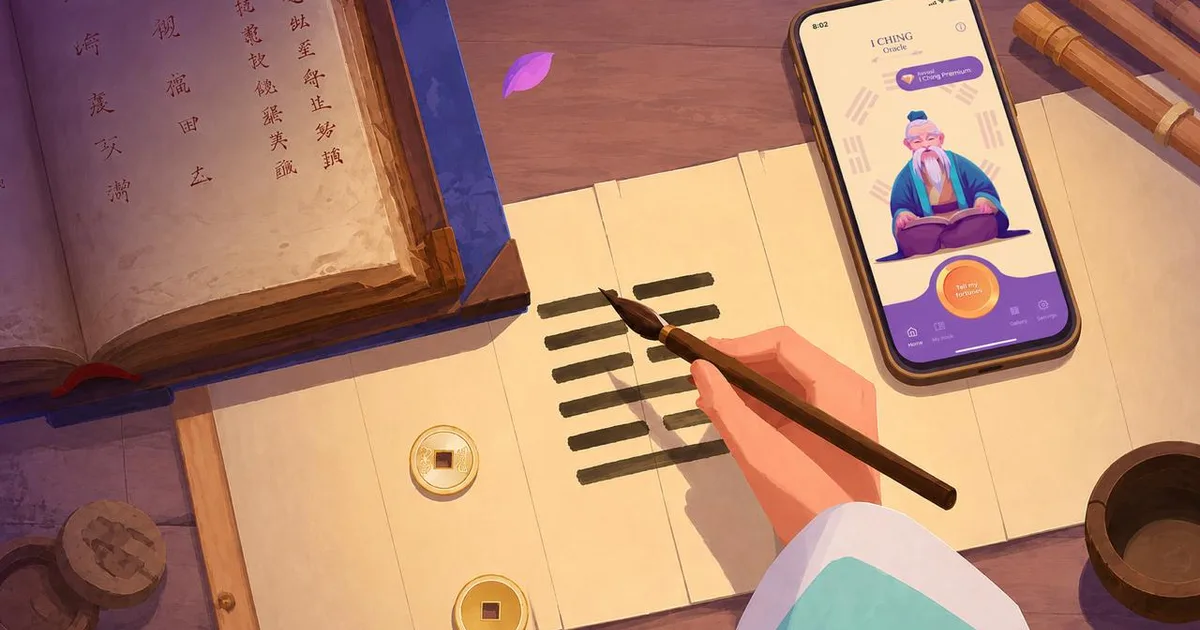
Once your question is framed, cast the hexagram — traditionally three coins tossed six times, or instantly with the I Ching: Fortune Teller app. In an anxious reading, pay attention to three layers:
- The primary hexagram — the situation exactly as it is right now, not as your anxiety has been narrating it.
- The changing lines — what's actually shifting, which is often narrower and more manageable than the anxiety made it feel.
- The resulting hexagram — the direction things are heading, if the current movement continues.
No changing lines suggests the situation is more stable than it feels — read the primary hexagram as the fuller picture. Several changing lines confirm you're genuinely in a transition, and the resulting hexagram is worth sitting with as much as the first.
Key Hexagrams for Uncertain Times
Some hexagrams appear again and again around anxious, unsettled moments. Here are seven worth recognizing.
Hexagram 29 — Recurring Danger
This hexagram describes moving through repeated risk or instability — one difficulty followed by another, without a clear break. Its advice isn't to avoid the danger but to move through it with steady, practiced attention, the way water keeps its course through anything in its path.
Hexagram 47 — Exhaustion
A hexagram of depletion — often appearing when anxiety has been running long enough to wear you down. It counsels rest and conservation over pushing harder, and a kind of quiet trust that the exhausted phase is not the permanent one.
Hexagram 39 — Impediment
This hexagram marks a real obstacle blocking forward movement — not imagined, but present. Its advice is patience paired with inner reflection rather than force: some blockages resolve on their own timeline, and pushing against them too hard just adds friction.
Hexagram 5 — Expectation
Waiting is an active state, not a passive one. Expectation appears when the anxious feeling is really about not knowing yet — a result pending, a decision in someone else's hands. It counsels calm preparation rather than forcing clarity before it's ready to arrive.
Hexagram 20 — Contemplation
A hexagram of stepping back to observe clearly, rather than reacting from inside the anxiety. It often shows up as a nudge to gain perspective — look at the wider situation from a slight distance before deciding anything.
Hexagram 52 — Concentration
This hexagram is about stillness — the mountain that doesn't move. When it appears, it's usually pointing at the value of grounding yourself before acting, rather than letting anxious momentum make the decision for you.
Hexagram 24 — Return
One of the most hopeful hexagrams to see during a hard stretch. Return describes the turning point after a low — the moment things quietly start moving back toward light, even if nothing dramatic has changed yet. It's often a sign that the worst of the current cycle has already passed.
A Short Example Reading
Say you're anxious about a situation with no clear timeline — a decision someone else needs to make, and you're stuck waiting. Instead of asking "will this work out?", you ask: "How should I be holding this uncertainty?"
You cast Expectation with one changing line, moving toward Return.
Read together, this suggests the waiting itself is the appropriate posture right now — not a sign you're doing something wrong. The changing line points to a shift already quietly underway beneath the surface. The resulting hexagram, Return, is reassuring: movement is coming back, even if it hasn't visibly arrived yet.
Not a promise that everything will be fine — a clearer read on where you actually stand inside the waiting.
That's the kind of steadiness a good I Ching reading offers during uncertain times: not a guarantee, but a clearer read on where you actually stand inside the waiting.
Common Mistakes When Anxious
- Asking for a guarantee. No honest reading can promise a specific outcome — chasing that kind of answer usually just extends the anxious loop.
- Casting repeatedly in one sitting. If a reading during an anxious spike feels unclear, that's often the anxiety itself resisting the answer — re-casting immediately rarely produces more clarity, just more noise. Our post on common mistakes when consulting the I Ching covers this pattern in more depth.
- Reading every hexagram as a warning. Hexagrams like Recurring Danger or Impediment describe a phase, not a permanent state — they're meant to be moved through, not feared.
- Skipping the changing lines. The changing lines usually mark exactly what's shifting under an anxious situation — skip them, and you miss the part of the reading most likely to actually settle you.
FAQ
Can the I Ching tell me if I have a reason to be anxious? Not directly — it doesn't diagnose feelings. What it can do is describe your actual situation clearly, which often reveals that the anxiety is larger than the circumstances themselves. If the anxiety feels persistent or overwhelming, that's worth bringing to a person, not just a hexagram.
What hexagram means things will get better? There's no single hexagram fixed to "it gets better," but Return often appears at a genuine turning point after a hard stretch, and Liberty can mark relief after built-up tension. The specific hexagram you draw always matters more than any general association.
Is it okay to consult the I Ching every day when I'm anxious? It's better used for a genuine, specific question than as a daily reassurance ritual — asking the same underlying worry repeatedly tends to produce noise rather than insight, and can end up feeding the anxiety instead of easing it.
What if I get a difficult hexagram during an already hard time? A hard hexagram describes a real condition, not a punishment. Hexagrams like Exhaustion or Impediment are often the most useful ones you can draw, because they name what's actually going on and point toward what helps — usually patience, rest, or a shift in approach.
Sitting with something uncertain right now? Cast a reading in the app and see which hexagram meets you where you are.