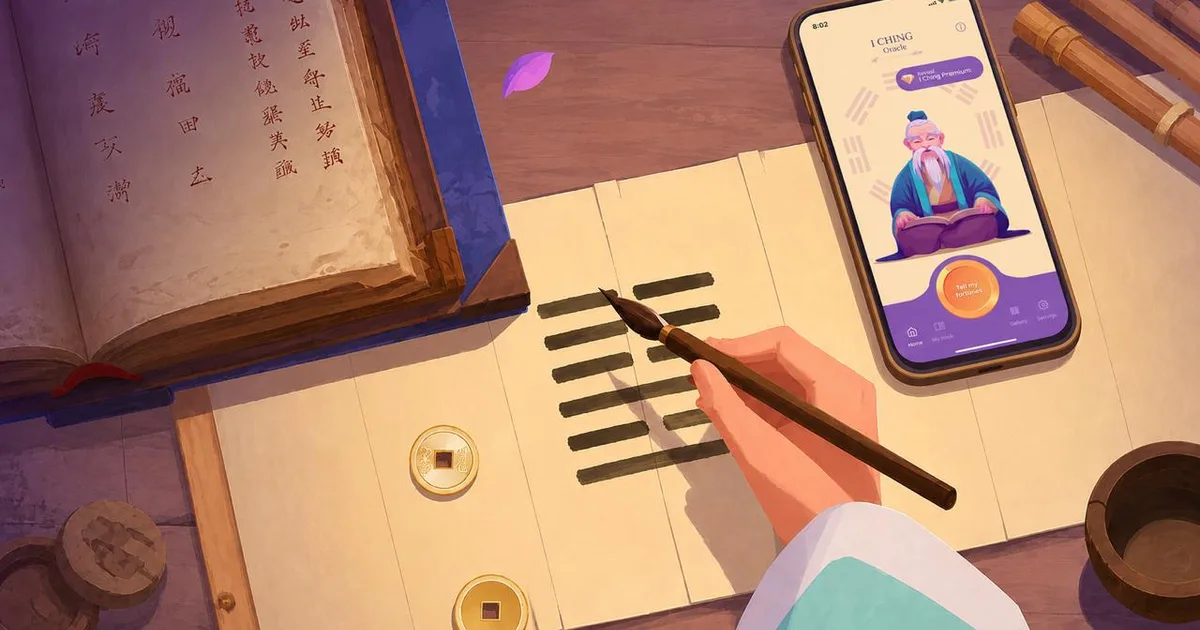
Yin and Yang Explained: The I Ching's Foundation
Almost everyone recognizes the black-and-white yin yang symbol. Far fewer know what yin and yang actually mean, or that the entire I Ching is built from nothing else. Every one of its 64 hexagrams is a combination of just two kinds of line: broken (yin) and unbroken (yang). Understand how those two forces relate, and the logic of the whole Book of Changes starts to make sense.
This guide explains where yin and yang come from, what each one represents, how they become the lines and hexagrams of the I Ching, and why the most important idea isn't the opposition between them but the way each one turns into the other.
What Yin and Yang Originally Meant
The words started out very concrete. In early Chinese, yin meant the shady side of a hill, and yang meant the sunny side. Same hill, same moment: one slope in shadow, the other in light. And as the sun moves through the day, the two sides swap.
That image already contains the whole idea. Yin and yang aren't two separate things. They're two aspects of one situation, defined by their relationship to each other, and always shifting. Over centuries, Chinese thinkers extended the pair from hillsides to everything: seasons, bodies, emotions, social roles, the movement of time itself.
Yin and yang began as the shady and sunny sides of one hill: two faces of a single moment, always trading places.
In the I Ching, this way of thinking is stated most clearly in the Ten Wings, the philosophical commentaries added to the core text. One of the most quoted lines says simply: "One yin, one yang: that is the Way." Reality, in this view, is the continuous alternation of the two.
The Qualities of Yin and Yang
Traditionally, each force is linked to a family of qualities:
Yin — receptive, yielding, still, inward, dark, cool, soft, the earth, night, rest, gathering.
Yang — active, firm, moving, outward, bright, warm, hard, the sky, day, effort, expanding.
These lists are useful, but they're easy to misread. Yin isn't weakness and yang isn't strength. Receiving, holding, and waiting take as much power as pushing forward, just a different kind. Water is the classic yin image in Chinese thought: soft and yielding, yet it wears down stone.
Each quality also only makes sense relative to the other. A room is "bright" compared to a darker room, "dark" compared to daylight outside. Nothing is purely yin or purely yang in itself, only more yin or more yang in relation to something else.
Yin and Yang Are Not Good and Bad
This is the most important point, and the one most often missed. Yin and yang aren't moral categories. Neither is the "right" one to have. A situation that needs patience calls for yin. A situation that needs initiative calls for yang. Trouble comes from the wrong one at the wrong time, or from too much of either.
The I Ching makes this concrete. Its first two hexagrams are pure yang (Creativity, six unbroken lines) and pure yin (Performance, six broken lines). They're presented as equal partners: the initiating force and the force that receives, completes, and gives form. As our Hexagram 1 deep-dive shows, even pure yang carries a warning in its top line: force that goes too far without restraint turns against itself.
This is also part of what separates the I Ching from systems built around fixed good or bad omens, a difference covered in I Ching vs Tarot.
How Yin and Yang Become I Ching Lines
The I Ching translates yin and yang into the simplest possible symbols:
- Yang is an unbroken line: ⚊
- Yin is a broken line: ⚋
Stack three lines and you get a trigram. With two kinds of line in three positions, there are exactly eight possible trigrams: Heaven (three yang), Earth (three yin), and six mixed ones: Thunder, Water, Mountain, Wind, Fire, and Lake. Stack two trigrams and you get a hexagram: six lines, 64 possible combinations. That's the whole system, built from a single pair. For how those pieces come together in an actual reading, see how to read the I Ching.
Line position matters too. Lines are read from the bottom up, and traditionally the odd positions (first, third, fifth) are considered yang positions, while the even ones (second, fourth, sixth) are yin positions. A yang line in a yang position is "correct," at home in its place. A yin line in a yang position is out of place, which often hints at tension. Commentators use this to explain why some lines are favorable and others carry a warning.
Changing Lines: Yin Turning Into Yang
This is where yin and yang stop being a static pair and become the engine of the Book of Changes. When you cast a hexagram with three coins, each throw gives one of four values:
- 7 — young yang: unbroken and stable
- 8 — young yin: broken and stable
- 9 — old yang: unbroken, but at its peak and about to turn into yin
- 6 — old yin: broken, but at its fullest and about to turn into yang
"Old" lines are the changing lines. They express the core insight of yin-yang thinking: any force pushed to its extreme turns into its opposite. Midday is the moment the light starts to fade. Midwinter is the moment the days start to lengthen. The changing lines mark exactly where in your situation that turn is happening, and when they flip, they produce a second, resulting hexagram showing where things are heading.
Every force carried to its extreme becomes its opposite. The changing lines show exactly where that turn is happening.
That's why the familiar black-and-white symbol has a dot of each color inside the other. That symbol came much later than the I Ching, but it captures the same idea: each force already holds the seed of its opposite.
Hexagrams That Show the Balance
A few hexagrams make the relationship between yin and yang especially visible.
Hexagram 11 — Dawn
Earth (yin) above Heaven (yang). It looks upside down, but it's one of the most favorable hexagrams in the book: heavy earth sinks, light heaven rises, and the two meet. The forces are in contact and exchange flows freely.
Hexagram 12 — Decline
The mirror image: Heaven above, Earth below. Each force moves away from the other, and nothing connects. It describes a period of standstill, when communication breaks down and it's wiser to hold back than to force things.
Hexagram 24 — Return
Five yin lines with a single yang line appearing at the bottom: the first return of light after the darkest point, traditionally linked to the winter solstice. A hexagram of quiet new beginnings.
Hexagram 23 — Destruction
The reverse movement: five yin lines pushing out the last yang line at the top. Yang is being worn away, and the advice is to hold still and wait rather than resist. It comes just before Return in the sequence, decline and renewal side by side.
Hexagrams 63 and 64 — Completeness and Incompleteness
In Completeness, every yin and yang line sits in its "correct" position: perfect order. Yet the text warns that order at its peak is the start of disorder. Incompleteness, with every line out of place, ends the whole book. The final word of the I Ching isn't arrival but a transition still in progress.
Common Misconceptions
- "Yin is female and yang is male, full stop." The tradition does link them to female and male, but only as one association among many. Every person and every situation contains both.
- "Yang is positive, yin is negative." Neither is better. The I Ching's guidance is almost always about the right one at the right time.
- "Balance means fifty-fifty." Balance in yin-yang thinking is dynamic, more like walking than standing still. Healthy situations keep shifting between the two.
- "The yin yang symbol is from the I Ching." The core text predates that symbol by many centuries. The I Ching expresses yin and yang through broken and unbroken lines, not the circle.
- "A yin-heavy hexagram is a bad sign." Return is almost entirely yin and is one of the most hopeful hexagrams there is.
FAQ
What does yin yang mean in simple terms? Yin and yang are two complementary forces present in everything: yin is receptive, still, and inward; yang is active, moving, and outward. Neither exists without the other, and each gradually turns into the other over time.
Is the I Ching based on yin and yang? Yes, entirely. Every line in the I Ching is either yin (broken) or yang (unbroken), and all 8 trigrams and 64 hexagrams are combinations of those two. The changing lines express how yin and yang turn into each other.
Which hexagram is pure yin, and which is pure yang? Hexagram 1 (Creativity) is six yang lines, and Hexagram 2 (Performance) is six yin lines. They open the sequence as the two foundational forces from which all other hexagrams are built.
What is an "old yin" or "old yang" line? It's a changing line. When a coin throw produces 6 (old yin) or 9 (old yang), that line has reached its extreme and is about to turn into its opposite. Changing lines create a second hexagram showing where your situation is moving.
Do I need to understand yin and yang to use the I Ching? No. You can consult it from your first reading. But knowing how yin and yang work makes the hexagrams much easier to read, because you can see why a hexagram means what it does, not just what the text says.
Want to see yin and yang at work in your own situation? Cast a hexagram in the app, or make it a habit with our guide to building a daily I Ching practice.