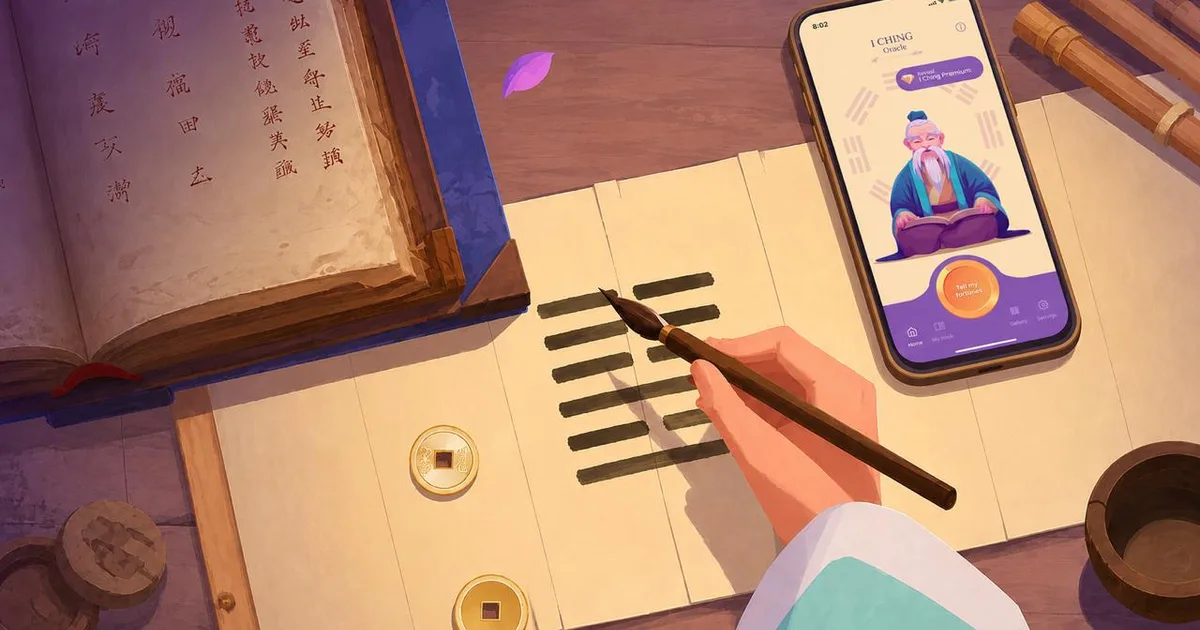
How to Build a Daily I Ching Practice
Most people first come to the I Ching with a big question: a decision, a relationship, a crossroads. That's a good way to start, but the Book of Changes also works well in a smaller, everyday form. A daily hexagram, drawn in the morning and read in a few minutes, works less like a forecast and more like a lens. It gives the day a theme to notice. Over weeks, the vocabulary of the 64 hexagrams stops feeling foreign and starts to feel like a language you can actually read.
This guide covers what a daily practice is (and isn't), a simple routine you can keep up, how to read a hexagram quickly without losing its depth, and how to see patterns once you've been at it for a while.
What a Daily Practice Is For
A daily draw isn't a way to predict whether today will be "good" or "bad." As covered in what the I Ching actually is, the text describes the shape of a moment rather than a fixed outcome. In daily use, that means the hexagram gives you one quality to pay attention to: patience, restraint, openness, effort, rest.
That small focus is the whole point. You carry it through the day, and in the evening you notice where it showed up. Some days it fits obviously. Some days it only makes sense in hindsight. Both are useful.
A daily hexagram isn't a forecast. It's one quality to carry through the day and notice in hindsight.
There's a second, slower benefit. Each hexagram you draw is one more you've seen in a real context, tied to a real day. After a month or two, names like Concentration or Return stop being abstract labels. You remember the day they showed up and what they meant then. That's how the I Ching becomes readable without memorizing anything.
A Simple Five-Minute Routine
The best routine is one you'll actually keep. This one takes about five minutes:
- Pick a fixed moment. Morning coffee, the commute, before opening email. Attaching the draw to something you already do every day is what makes it stick.
- Take one breath and settle. You don't need a ritual, just a short pause between the rush of the morning and the question.
- Ask a simple question. Something like "What should I keep in mind today?" (more on framing below).
- Cast one hexagram. Three coins tossed six times, or a single tap in the I Ching: Fortune Teller app. The app also shows a Daily Hexagram on the main screen and can put it on a Home Screen widget, so the sign is already waiting when you pick up your phone.
- Read the core text, then pick one phrase. Not the whole commentary, just the line or image that stands out. That phrase is your note for the day.
In the evening, give it one more minute: where did that quality show up? That short look back is where most of the learning happens.
What to Ask on an Ordinary Day
A daily question should be open, not anxious. You're not asking the I Ching to settle anything, just to point your attention somewhere useful. For the general rules of framing, see how to read the I Ching. For daily use, a few open questions work well:
- "What should I keep in mind today?"
- "What quality will help me most today?"
- "Where should I put my attention?"
- "What am I likely to overlook today?"
Pick one and keep it for a few weeks. Using the same question every day makes the answers easier to compare. When the question stays fixed, any change in the hexagram reflects a change in the day, not in how you asked.
Save bigger questions about a decision, a relationship, a job for separate, dedicated readings. Mixing a life decision into the morning draw puts too much weight on a five-minute habit.
Reading a Daily Hexagram Quickly
A daily reading doesn't need the full depth of a decision reading. Three layers are enough:
- The name. Often it carries most of the message on its own. Humility, Limitation, Joy: even a single word gives the day a direction.
- The Judgment. The short verdict tells you whether the hexagram calls for action, waiting, or adjustment.
- One changing line, if any. If you drew changing lines, read only the one that speaks to you most. In daily practice it usually points to the specific moment where the theme will be tested.
If you have more time, look at the resulting hexagram too, the direction the day is moving. But don't feel obliged to. A quick, honest reading every day beats a thorough one you skip because it takes too long.
Keeping an I Ching Journal
A journal turns a daily habit into something you can learn from. It doesn't need to be elaborate. Each entry needs four things:
- The date and the hexagram (number and name, plus any changing lines)
- The phrase you chose in the morning
- One sentence in the evening about where it showed up, or didn't
- Anything surprising
After a few weeks, read back through it. You'll start to notice patterns: a hexagram that keeps coming back during a particular stretch, themes that cluster around certain kinds of weeks, hexagrams that seemed wrong in the morning and made perfect sense by evening. These patterns are often more revealing than any single reading.
One hexagram is a snapshot. A month of them is a story about where your life is moving.
A recurring hexagram deserves extra attention. If Expectation shows up four times in two weeks, it's worth asking what you're waiting for, and whether the waiting is still serving you.
Hexagrams You'll Meet Often
With 64 hexagrams, each one comes up about once every two months on average, but some themes feel especially familiar in daily practice. Here are six worth knowing.
Hexagram 1 — Creativity
Pure initiating energy: a day to start things, take the lead, and act on what you've been planning. Our Hexagram 1 deep-dive covers its six lines in detail.
Hexagram 2 — Performance
The receptive counterpart to Hexagram 1. A day to follow, support, and respond well rather than push your own agenda. It's not passive, just a different kind of strength.
Hexagram 52 — Concentration
Stillness, like a mountain. A day to stay focused, say no to distractions, and avoid acting just to feel busy.
Hexagram 15 — Humility
A day where modesty pays off: listening more than talking, letting results speak for you, keeping your ego out of small conflicts.
Hexagram 42 — Increase
A favorable, expanding day. Good for effort, generosity, and starting something you want to grow. Momentum is on your side.
Hexagram 60 — Limitation
A reminder about boundaries: of time, money, energy, or commitments. Not a restriction for its own sake, but the kind of limit that keeps things sustainable.
Common Mistakes
- Re-casting when you don't like the answer. One draw per day. If the hexagram feels wrong in the morning, keep it anyway and check again in the evening. That mismatch is often the most interesting part.
- Treating it as a mood forecast. A "difficult" hexagram doesn't mean a bad day, just a day with a particular challenge to notice. Hexagrams like Impediment often bring the most practical advice.
- Turning it into a reassurance ritual. If you notice yourself drawing to calm the same worry every morning, that's a different need. Our guide to the I Ching for anxiety and uncertain times covers how to approach that more helpfully.
- Reading too much. Daily practice works because it's short. Reading every commentary every morning is the fastest way to burn out and quit.
- Skipping the evening check. Without the look back, the morning draw is just a quote of the day. The evening minute is what turns it into practice.
FAQ
Is it okay to draw a hexagram every day? Yes, as long as the daily draw is an open question for reflection, not the same worry asked again and again. A fixed, neutral question like "what should I keep in mind today?" is exactly what daily practice is for.
Should I use coins or an app for a daily reading? Either works; the underlying method is the same. Coins make the moment feel more deliberate. An app makes the habit easier to keep, which matters more for a daily practice. Many people use coins on weekends and the app on busy weekdays.
What if I draw the same hexagram several days in a row? Pay attention to it. A repeating hexagram usually points to a theme that hasn't been resolved yet. Read its changing lines more carefully, and ask what in your situation keeps calling for that same quality.
How long before a daily practice starts to feel meaningful? For most people, two to four weeks. The first days can feel random. Once you have a journal to look back on and have met a few hexagrams more than once, the connections become much easier to see.
Can I keep a daily practice and still do bigger readings? Yes, and the two work well together. Daily draws build familiarity with the hexagrams; dedicated readings handle real decisions. The more hexagrams you've met in daily life, the easier those bigger readings become to interpret.
Want to start tomorrow morning? Draw your first daily hexagram in the app, and for the ideas behind every line you'll draw, read Yin and Yang Explained.